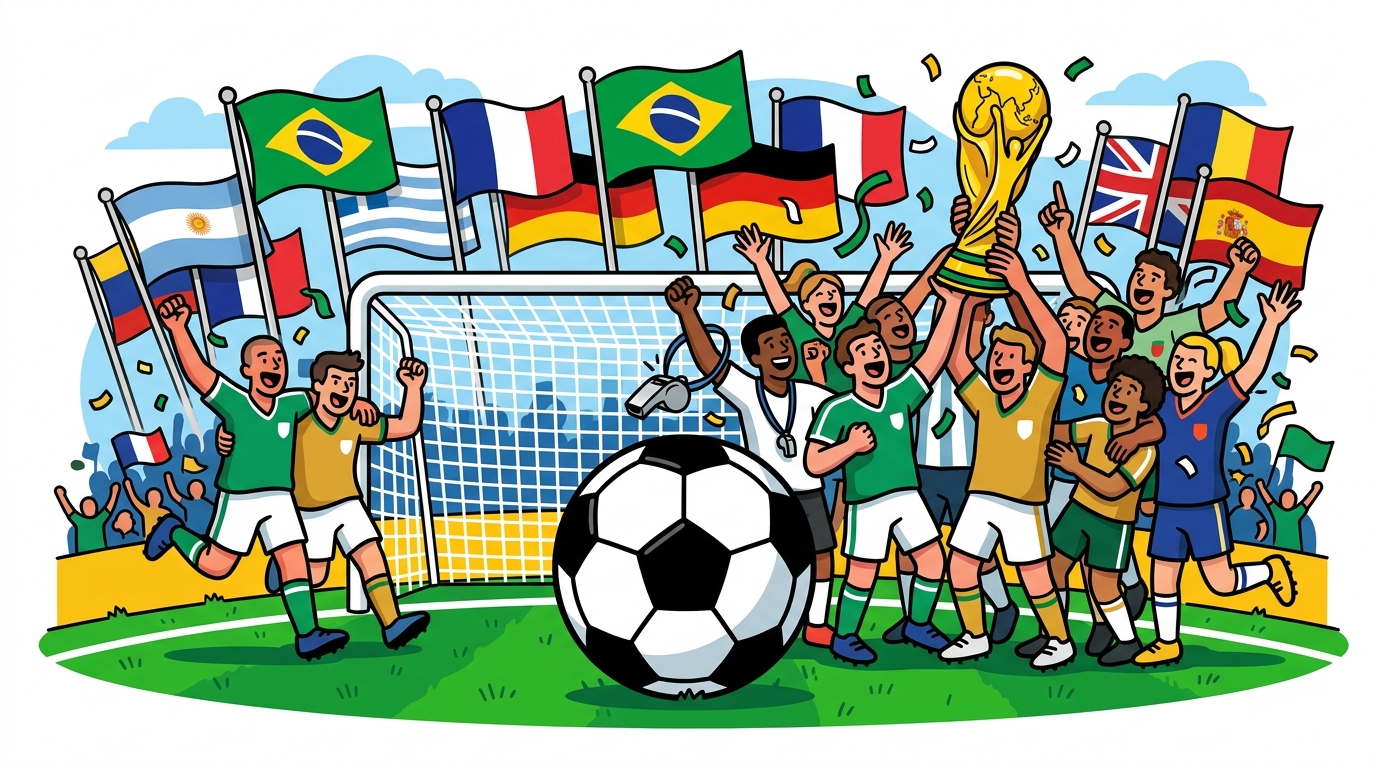
What is World Cup Bingo?
World Cup Bingo is the ultimate game for football fans during the 2026 World Cup in the United States, Canada and Mexico. Every player gets a card filled with participating nations (USA, Argentina, Brazil, Morocco and more) and typical football moments: penalty, hat-trick, stoppage time, VAR check. During the match you cross off every spotted moment or country — first to a row or full house shouts BINGO!
Which countries are on the cards?
Our World Cup bingo includes 48+ participating nations across all continents: Europe (France, Germany, Spain, England, Netherlands, Italy, Portugal, Belgium, Croatia and more), South America (Argentina, Brazil, Uruguay, Colombia, Ecuador), Africa (Morocco, Senegal, Egypt, Nigeria, Ghana, Ivory Coast, Cameroon), Asia (Japan, South Korea, Iran, Saudi Arabia, Australia), North/Central America (USA, Canada, Mexico, Costa Rica, Panama) and Oceania (New Zealand). Plus 50+ football terms for extra fun.
Meer over dit thema
Picture this: a living room packed with three generations of football fans, eyes glued to the screen as Morocco pulls off another stunning upset. Suddenly, Grandma shouts "BINGO!" She's marked off VAR check, yellow card, and corner kick in rapid succession. The room erupts in laughter—she's beaten the football purists at their own game.
The FIFA World Cup transcends sport. Since Uruguay hosted the inaugural tournament in 1930 with just thirteen nations, it has grown into a global phenomenon that stops the world every four years. The 2026 edition marks a historic expansion to 48 teams across Canada, Mexico, and the United States, bringing unprecedented diversity to the pitch. From the tiki-taka artistry of Spain to the joga bonito flair of Brazil, from Japan's disciplined precision to Argentina's passionate attacking football, the tournament showcases every football philosophy ever devised.
World Cup bingo bridges the knowledge gap that often divides casual viewers from devoted fans. In primary schools across Europe and Latin America, teachers use it during the final week before summer break when concentration wanes but World Cup fever peaks. Eight-year-olds who barely understand offside suddenly care deeply about penalty kicks and hat tricks. The game transforms passive watching into active participation, making every substitution and free kick matter to everyone in the room.
Corporate event planners have discovered its magic for tournament viewing parties. When a tech company in Seattle hosts 80 employees for the USA match, World Cup bingo keeps energy high during halftime and gives non-football fans a stake in the action. Family reunion organizers praise it for uniting cousins aged six to sixty-six, turning awkward silences into competitive banter when someone marks off their fifth country or spots another trophy close-up.
Parents hosting neighbourhood watch parties benefit most—the game occupies restless children during tense nil-nil draws while giving adults permission to shout at referee decisions. Teachers appreciate the accidental geography lessons as students learn to recognize flags and pronounce Côte d'Ivoire correctly. HR managers love how it democratizes company gatherings, letting the receptionist who's never watched football compete equally with the office's self-appointed pundit. The beautiful game becomes even more beautiful when everyone has a card and a chance to win.
Playing World Cup Football Bingo
Before kickoff, generate and print one unique bingo card per player using the automatic fill feature to ensure no two cards are identical. For authentic tournament atmosphere, provide mini football stress balls or flag stickers as daubers instead of traditional markers. Each player needs a clear view of the television and their card—arrange seating accordingly.
Standard rules work beautifully: players mark items as they occur during the match. When the referee shows a yellow card, everyone with "Gele kaart" on their card marks it. When Netherlands scores, anyone with "Nederland" gets to mark that square. The FREE space in the centre counts automatically. First player to complete a horizontal, vertical, or diagonal line calls out "GOOOAL!" instead of "Bingo!" to stay thematic.
For World Cup marathon viewing, try the Accumulator variant: cards stay active across multiple matches in a single day, so that yellow card from the morning game and the penalty from the afternoon match both count toward your pattern. This works brilliantly during the group stage when four matches air back-to-back. Alternatively, play Match-Specific mode where cards reset each game, creating faster rounds perfect for viewers with shorter attention spans.
A five-by-five grid suits most World Cup settings, providing enough variety without overwhelming casual fans. Groups of four to fifteen players hit the sweet spot—enough competition to stay exciting without making winner verification chaotic. For larger viewing parties of 20-plus, consider team-based play with groups of four sharing cards.
Timing matters: a typical group stage match yields 2-3 bingo winners over 90 minutes plus stoppage time. High-scoring games produce faster rounds, while defensive 1-0 grinders require patience. Plan for extra rounds during knockout stage penalty shootouts, when drama peaks and multiple cards often complete simultaneously as players frantically mark "Penalty" squares.
Items on World Cup Cards
Each square represents a team, action, or iconic World Cup moment you'll spot during tournament matches:
- VAR check — Video Assistant Referee technology debuted at the 2018 World Cup and instantly became controversial, with lengthy reviews sometimes lasting three minutes while 80,000 fans and millions watching worldwide hold their breath.
- Penalty — Penalty kicks account for approximately one goal in every four World Cup matches, and penalty shootouts have decided 30 knockout stage games since Argentina beat West Germany on penalties in 1990.
- Brazilië — Brazil remains the only nation to have competed in every single World Cup since 1930 and holds the record with five championship trophies, making their iconic yellow jersey instantly recognizable worldwide.
- Hattrick — Scoring three goals in one match is rare enough that only 52 hat tricks have occurred across World Cup history, with Geoff Hurst's 1966 final performance remaining the only one in a championship match.
- Argentinië — Argentina's passionate football culture produced legends Diego Maradona and Lionel Messi, with their 2022 championship victory ending a 36-year drought and sending Buenos Aires into celebrations lasting weeks.
- Rode kaart — Red cards force teams to play with ten players for the remainder of the match, a severe handicap that has directly influenced the outcome of 47 World Cup games throughout tournament history.
- Marokko — Morocco made history in 2022 by becoming the first African nation to reach a World Cup semifinal, captivating the Arab world and proving that traditional football powerhouses no longer monopolize success.
- Buitenspel — The offside rule confuses billions of casual viewers, yet referees call it dozens of times per match, often canceling spectacular goals and generating heated debates about millimeter-precise VAR lines.
- Hoekschop — Corner kicks generate approximately 120 scoring opportunities throughout a typical 64-match World Cup tournament, with set-piece specialists practicing these dead-ball situations for hundreds of hours.
- Doelpunt — World Cup goals carry extraordinary weight, with the tournament's all-time leading scorer Miroslav Klose needing just 16 goals across four tournaments to claim the record—fewer than many strikers score in a single club season.
- Japan — Japanese fans became legendary for cleaning stadium stands after matches, a practice that gained global attention in 2018 and inspired supporters of other nations to follow their example of respect and consideration.
- Trofee — The solid gold FIFA World Cup Trophy weighs 6.1 kilograms, stands 36.8 centimeters tall, and depicts two human figures holding up the Earth, with television cameras capturing it dozens of times each match as the ultimate prize.
World Cup Bingo Variations
Team Tournament mode transforms individual competition into group strategy. Divide your viewing party into four-person teams representing different confederations—UEFA, CONMEBOL, CONCACAF, and everyone else. Teams share a single master card and must collectively spot items, encouraging collaboration and teaching casual fans to recognize gameplay elements they might miss alone. First team to three bingos across the tournament's opening day wins a prize basket of international snacks from participating nations.
Pattern variations add thematic flair beyond standard lines. Try the Golden Boot pattern requiring all four corners plus centre (mimicking a football diamond), or the Trophy shape where players must complete the entire outer edge of their card before the tournament final ends. Group stage viewing parties work well with simpler patterns like any single line, while dedicated fans watching knockout rounds appreciate Championship Challenge requiring a full card blackout, typically achievable only during extra time or penalty shootouts when chaos generates rapid item marking.
Prize selection amplifies the World Cup atmosphere. Award winners with national team scarves from tournament participants, football trading card packs, or vouchers to local sports pubs for the next match. One creative host gives winners "Golden Ticket" privileges to choose which match the group watches next when multiple games air simultaneously. Avoid generic gift cards—theme-specific prizes reinforce the football culture and give winners bragging rights beyond a simple victory.
Hybrid viewing works brilliantly for geographically dispersed friend groups. Create a shared WhatsApp group where remote players post photos of their marked cards when claiming bingo. Use video calls during halftime for verification and banter. Some groups maintain running leaderboards across all 104 tournament matches, with the overall champion crowned after the final. Digital cards on tablets prevent printing costs but reduce the satisfying tactile experience of daubing physical cards during dramatic moments.